
Methyl Acrylate Suppliers, Dealers in Mumbai, India
Methyl Acrylate – A Key Monomer for Polymer Synthesis
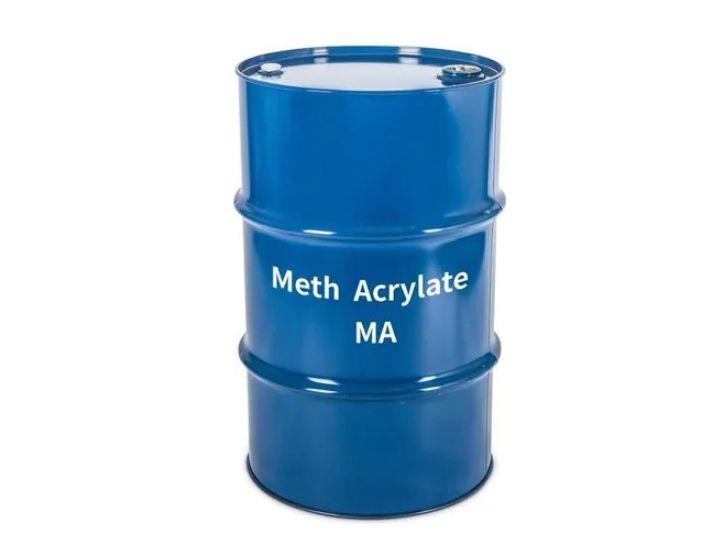
Methyl Acrylate (MA) is a vital industrial monomer renowned for its role in synthesizing polymers and copolymers with fast-setting, high-performance applications. With its low viscosity and excellent reactivity owing to the activated double bond, MA finds widespread use in adhesives, coatings, textiles, and elastomers. Shakti Chemicals offers superior-grade Methyl Acrylate. It is engineered under stringent quality systems to deliver consistent purity, low residual inhibitors as well as reliable performance in diverse processes.
What is Methyl Acrylate?
Methyl Acrylate is chemically known as methyl prop-2-enoate. It possesses the formula as C₄H₆O₂. It is a colorless or pale yellow liquid with a sharp & acrid smell. It is fully miscible with most organic solvents a s well as exhibits partial water solubility. As appearance wise it belongs to the acrylic ester family. It is made up of an ester group (-COOCH₃) attached to a double bond. This shows high reactivity towards free-radical polymerization.
Functionally, MA is mainly employed as a monomer in the production of poly(methyl acrylate) & also copolymers. These copolymers are such as styrene-acrylate & also acrylonitrile–butadiene–styrene (ABS). These materials exhibit advantageous properties including flexibility, weather resistance as well as strong adhesion. This makes them important in pressure-sensitive adhesives (PSAs), protective coatings, sealants as well as textiles. In addition, derivatives of methyl acrylate serve as intermediates in the synthesis of pharmaceuticals, agrochemicals & also specialty chemicals.
Key processing advantages include its low viscosity (~0.8 cP at 25 °C). This thing facilitates easy handling as well as pumping in industrial systems. It's activated double bond allows rapid polymerization under moderate temperatures (50–80 °C) using radical initiators (e.g. AIBN, benzoyl peroxide). However, MA requires care in storage and handling due to its propensity to polymerize or degrade through oxidation. Typically, a stabilizer which is hydroquinone monomethyl ether (MeHQ) is added at ~200–300 ppm to preserve stability. Overall, methyl acrylate's versatility as well as reactivity underpin its importance across multiple industrial domains
Chemical Specifications
| Property | Details |
|---|---|
| Chemical Name | Methyl Acrylate (CAS No. 96-33-3) |
| Appearance | Colorless to pale yellow liquid |
| Molecular Formula | C4H6O2 |
| Purity | ≥ 99.0% (GC) |
| Distillation Range | > 80–82 °C @ 5 mmHg |
| Molecular Weight | 86.09 g/mol |
| Refractive Index (n²⁰ᴰ) | 1.406–1.409 |
| Density (20 °C) | 0.955–0.960 g/cm³ |
| Refractive Index (n²⁰ᴰ) | 1.406–1.409 |
| Viscosity (25 °C) | ~0.8 cP |
| Inhibitor | MeHQ @ 200–300 ppm |
| Water Content | ≤ 0.02% |
| Residual Acrylic Acid | ≤ 0.05% |
| Residual Solvents | ≤ 0.1% |
| Color (Gardner Scale) | ≤ 2 |
| Polymer Content | ≤ 10 ppm |
Specifications
•Boiling Point: Approximately 80–82 °C at atmospheric pressure, which supports easy removal in solvent recovery and purification processes.
•Flash Point (Closed Cup): It is around 4 °C, which indicates the need for flameproof storage as well as handling environments.
•Autoignition Temperature: Approximately 455 °C which is relevant for assessing fire hazards in processing landscape.
•Vapor Pressure: About 90 mmHg at 20 °C which contributes to its volatility as well as evaporation rate during open operations.
•Log P (Octanol/Water Partition Coefficient): ~0.8 which indicates moderate hydrophilicity as well as relevance for environmental risk assessments in effluent discharge.
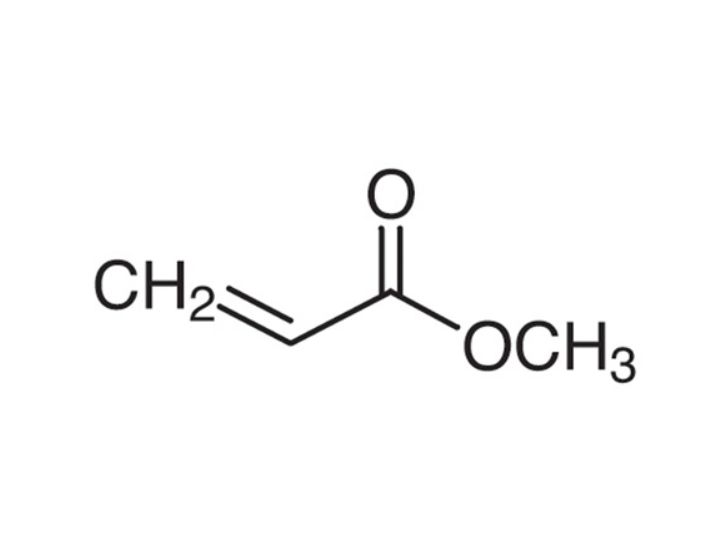
Structure of Methyl Acrylate
Methyl Acrylate features:
H₂C=CH—C(=O)—O–CH₃
Double bond (vinyl group): These are positioned between C1–C2 enables radical polymerization.
Ester moiety: Between C2–C3, it offers solubility in organic media & also influences polymer flexibility.
Methyl ester side chain: This contributes to Tg reduction as well as polymer solubility balance.
Planar configuration: This owes to conjugation. In this the vinyl group aligns with the ester, increasing polymerization kinetics.
Handling and Storage
Hazards: Methyl Acrylate is moderately flammable (flash point ~4 °C) and can polymerize violently when heated or in the presence of peroxides. It can also irritate eyes, skin as well as respiratory tract.
Storage Guidelines:
Maintain ambient storage temperature between 10–25 °C.
Keep containers tightly closed under an inert gas blanket (nitrogen).
Shield from direct sunlight and heat.
Use stabilized items with 200–300 ppm MeHQ; replenish stabilizer if depletion is suspected.
Dedicated drum storage areas with controlled temperature and secondary containment.
Handling Precautions:
Use in well-ventilated settings or closed-loop systems.
Wear chemical-resistant gloves (e.g., nitrile), safety goggles, and flame-resistant lab coats.
Have PPE and bibulous absorbents nearby for small spills; for large spills, use inert absorbents (e.g., sand) and transfer to labeled disposal drums.
Control sources of ignition. There should be no open fires, sparks, or smoking in storage or usage zones.
Monitor inhibitor levels regularly.Industries often test residual MeHQ before major polymerization runs.
Why Choose Shakti Chemicals
Quality Suppliers, exporter: Shakti Chemicals in Maharashtra maintains ISO-certified manufacturing facilities providing high-purity Methyl Acrylate to industrial clients worldwide.
Efficient Traders: With an expansive supply chain, they efficiently procure raw monomers and deliver them on time.
Dependable Dealers: Regional dealer networks ensure prompt availability across key markets.
Trusted Importers: Authorized to import MA under regulatory compliance, offering consistent supply to countries with restricted local production.
Authorized Distributors: Certified to distribute Methyl Acrylate across sectors—coatings, adhesives, textiles, pharmaceuticals—backed by robust technical support and product documentation.
Product Pack Size
IBC Containers: 1,000 kg net
Steel Drums: 200 kg net per drum
ISO Tanks: 20 MT for bulk shipments
Special Packaging: Custom sizes (e.g. 500 kg totes, 450 kg composite drums) available on request
Each unit is clearly labeled with lot number, production date, purity, inhibitor information, and safety markings compliant with GHS.
Applications of Methyl Acrylate
Acrylic & Ethylene-Acrylic Emulsions – For architectural coatings and sealants.
Pressure-Sensitive Adhesives (PSAs) – Applicative in tapes and labels due to tacky, flexible polymers.
Textile Finishing Agents – Used in binder resins for nonwoven fabrics and garment coatings.
Elastomers & Resilient Polymers – Co-polymerized with butadiene and styrene to make flexible ABS, impact modifiers.
Primer & Coating Systems – Enhances primer adhesion and weather durability in two-component polyurethanes.
Protective Overcoats – Applied in automotive clear-coat systems for abrasion and UV resistance.
Specialty Resins – Serves as chemical intermediate for pharmaceutical and agrochemical synthesis.
Photopolymer Resists – Used in photoresist emulsions due to fast drying and film formation.
Reactive Diluents – Monomeric diluent in UV-curable coatings to reduce viscosity without curing compromise.
Water-Based Dispersions – A core component in latex formulations for paints, paper coatings, and laminates.
FAQs
Is Methyl Acrylate flammable?
Yes—its flash point is ~4 °C, making it highly flammable. Keep away from ignition sources and store between 10–25 °C.
What stabilizer is used in MA?
MeHQ (hydroquinone monomethyl ether) is added at 200–300 ppm to prevent unwanted polymerization.
How should MA be stored long-term?
Store under nitrogen, in airtight containers, at ≤25 °C, with periodic inhibitor checks.
Can it be polymerized directly?
Yes, under free-radical conditions using initiators (AIBN, BPO), typically at 50–80 °C.
Is MA soluble in water?
It has limited water solubility (~5.5% at 20 °C), but is fully miscible with organic solvents.
What impurities should be monitored?
Monitor residual acrylic acid (must be <0.05%), water (<0.02%), and polymerized residues (<10 ppm).
Is it hazardous to health?
MA can irritate skin, eyes, and respiratory tract. Use PPE and operate in ventilated settings.
What industries use MA?
Paints & coatings, adhesives, textiles, plastics, pharmaceuticals, and agrochemicals are key sectors.
How can you test inhibitor depletion?
Titration against KI/Na₂S₂O₃ or HPLC can quantify MeHQ levels before polymerization use.
What’s its typical viscosity?
Very low—approximately 0.8 centipoise at 25 °C—allowing easy pumping and mixing.
Methyl Acrylate is a versatile industrial monomer characterized by its low viscosity, high reactivity, and wide application range—from adhesives and coatings to specialty polymers and intermediates. Its chemical structure facilitates rapid, controllable polymerization, while its handling and storage requirements—flash point awareness, inhibitor stabilization, and ambient temperature controls—ensure safety and performance. Shakti Chemicals delivers top-grade Methyl Acrylate as trusted suppliers, traders, dealers, importers, and distributors, backed by rigorous quality monitoring and global logistics in Mumbai, India. For formulators seeking reliability, purity, and tailored solutions, this MA offering supports a diverse spectrum of industrial synthesis and processing needs.
Get in Touch with Us
Looking for high-quality Methyl Acrylate? Contact us today for bulk orders and technical details.
Contact Us- Address: 206-207, 2nd Floor, Wadala Udhyog Bhavan, Naigaon Cross Road, Wadala (West)
- Email: info@shaktichemicals.org
- Phone: +91 4044 0000