
N-Butyraldehyde Suppliers, Dealers in Mumbai, India
n-Butyraldehyde (Butanal)
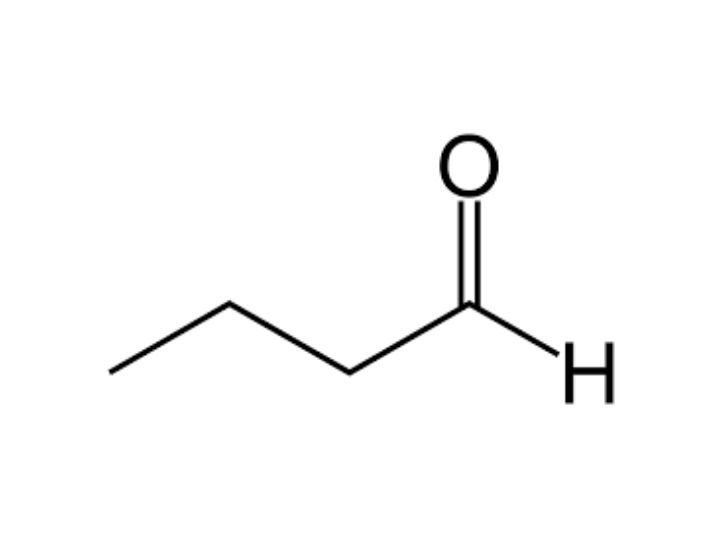
N Butyraldehyde (also known as butanal) is a colorless, flammable, all-rounder aldehyde. It shows with the formula C₄H₈O and a characteristic sharp, pungent odor. Among C₁–C₄ aldehydes, it holds a niche position as an essential building block in organic synthesis and industrial chemical production. It finds broad utility across multiple applications. These applications are from flavor and fragrance synthesis to fuel additives as well as pharmaceutical intermediates. Produced industrially via cuprous chloride–catalyzed or cobalt–manganese–bromide–catalyzed selective oxidation of n butane. Its scalable production underscores its economic viability.
What is N-Butyraldehyde?
N Butyraldehyde is a saturated aliphatic aldehyde. It is also called butanal. It consists of a four-carbon linear chain terminated with an aldehyde (–CHO) functional group. The carbon atom adjacent to the terminal –CHO is the primary one, i.e, first Carbon. This gives the molecule formula of CH₃–CH₂–CH₂–CHO. The aldehydic hydrogen makes it reactive towards nucleophiles, making it essential in aldol condensations, reductive aminations, and the formation of secondary or branched alcohols and acids.
It’s a low-molecular-weight, hydrophobic compound with a boiling point around 75–77 °C and a flash point of approximately –21 °C, highlighting its flammability. Slightly soluble in water (~7 g/L at 20 °C), it is miscible with most polar organic solvents such as ethanol, acetone, and diethyl ether. The vapor density (~2.3 vs air) and high volatility necessitate proper ventilation when handling.
In industrial chemistry, n butyraldehyde serves as a key precursor to 2-ethylhexanol via aldol condensation followed by hydrogenation. This derivative is a major plasticizer. It is used in polyvinyl chloride (PVC). It is also an intermediate in the production of butyraldehyde oxime. This particular compound yields methyl ethyl ketone oxime (MEKO). It is a solvent and anti-skinning agent. Other applications include synthesis of pharmaceuticals, agrochemicals, and flavor/fragrance ingredients like cinnamaldehyde and butyl acetate.
Due to its sensitivity to light and mild oxidants, n butyraldehyde can form peroxides or undergo polymerization—hence requiring stabilizers (e.g., hydroquinone) and an inert atmosphere during storage. Its chemical all-rounder ability, combined with effective safety as well as stabilization protocols, underpins its widespread industrial adoption.
Chemical Specifications
| Property | Details |
|---|---|
| CAS Number | 123-72-8 |
| Chemical Name | N-Butyraldehyde (Butanal) |
| Molecular Formula | C4H8O |
| Molecular Weight | 72.11 g/mol |
| Appearance | Colorless to pale yellow liquid |
| Boiling Point | –21 °C (closed cup) |
| Density (20 °C) | 0.81 g/cm³ |
| Water Solubility | ≈7 g/L |
| Refractive Index (nD) | 1.396–1.398 |
| Vapor Pressure (25 °C) | –21 °C (closed cup) |
| Typical Impurities | Butanol, crotonaldehyde, acetaldehyde |
| Stabilizer | Hydroquinone (~10–50 ppm) or equivalent |
| Color Indicator | ≤ 10 Pt/Co |
| Storage Conditions | Cool, dark, well-airy, inert atmosphere |
| Shelf Life | ≥ 12 months in sealed container |
Specifications
Purity (GC): ≥ 99.5 % — ensures minimal impurity interference in downstream reactions.
Hydroquinone: 10–50 ppm — This compound prevents polymerization as well as peroxide formation during storage.
Moisture Content: ≤ 0.1 % — low levels to avoid side reactions.
Acid Value: ≤ 0.02 mg KOH/g — This indicates lesser acidic impurity presence.
Color: ≤ 10 Pt/Co units — These are visual indicators of freshness as well as purity.
Heavy Metals: ≤ 0.5 ppm (As, Hg, Pb) — for compliance with industrial safety standards.
Residue on Evaporation: ≤ 0.02 % — confirms absence of high-boiling impurities.
Trace Water: Determined via Karl-Fischer titration.
Nitrogen & Chlorides: ≤ 1 ppm total — to prevent corrosion and catalyst poisoning.
Handling and Storage
1. Handling
o Use only in well ventilated fume hoods or equipped areas.
o Wear appropriate PPE: chemical-defiant gloves (nitrile or neoprene), safety goggles as well as suitable lab coats.
o Avoid ignition sources: open fires, hot surfaces as well as static discharge.
o For transfers, use closed systems or dry gas/vacuum transfers; inert gas blanketing recommended.
o In case of spills, eliminate ignition sources, absorb with inert material, and dispose per hazardous waste protocols.
2. Storage
o Store in airtight, chemical-defiant containers (HDPE or steel with chemical lining).
o Maintain temperature below 25 °C. It should be ideally at 15–20 °C.
o Protect from light as well as atmospheric oxygen—use opaque containers.
o Inert gas blanket (nitrogen or argon) recommended in headspace.
o Separate from strong oxidizing agents as well as acids.
o Try to use adequate bonding/grounding to avoid static buildup.
o Keep fire suppression tools like dry chemical, CO₂ nearby.
3. Disposal
o Do not pour down drain.
o Collect in labeled hazardous waste containers for better disposal.
o Treat by chemical neutralization or incineration at a licensed facility following local regulations.
Structure of N-Butyraldehyde
N-Butyraldehyde exhibits a linear four-carbon chain. Its structural breakdown:
C4H8O2
C1 (terminal aldehyde carbon): This C is doubly bonded to oxygen (C=O) as well as singly bonded to hydrogen and C2.
C2 and C3: These are methylene (-CH₂-) groups forming the backbone.
C4: It is a methyl (-CH₃) terminal end of this compound.
Key bond angles are approx 120° from the carbon. Here the molecule adopts a near-anti planar conformation due to minimal steric hindrance. Electronic polarization of the carbon & oxygen bond (carboxyl) starts the carbonyl carbon to nucleophilic attack. This makes it chemically versatile.
Why Choose Shakti Chemicals
Shakti Chemicals in Mumbai, India has earned a reputation among suppliers, exporter, traders, dealers, importers, and distributors for delivering high-quality N-Butyraldehyde with exceptional service credentials:Top-grade Purity
High-performance GC-certified purity ≥ 99.5 %, ensuring optimal downstream reaction outcomes.
Stringent QC Practices
All lots tested for moisture, color, acid value, and heavy metals; issued with detailed batch analysis certificates.
Robust Stabilization
Incorporates hydroquinone or equivalent stabilizers and chemical oxygen scavengers to maintain product integrity throughout storage.
Secure Packaging
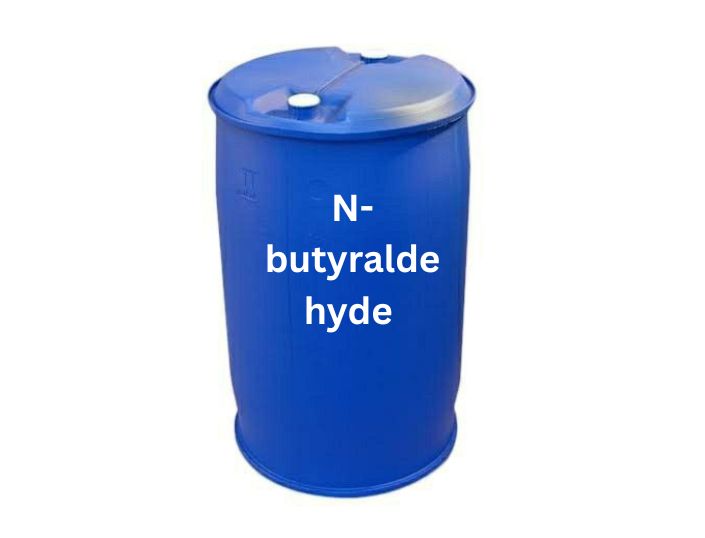
Available in steel drums and UN-approved IBCs, featuring nitrogen-blanketed headspace, ensuring maximum safety and zero product degradation.
Custom Packing Options
From 200 kg to 1,000 kg, with flexibility for special container requirements, including lined drums or reefer containers.
Global Distribution Network
Extensive presence across Asia, Europe, and North America. Prompt export/import service with full customs & regulatory support.
Regulatory Compliance
Conforms to major industrial certifications (ISO, ECO, REACH, KOSHA, JIS). MSDS, COA, shipping docs provided.
Technical Support & R&D
Expert technical team assists with applications—aldol condensations, fragrance synthesis, plasticizer intermediates, and safety guidelines.
Competitive & Transparent Pricing
Bulk pricing options, clear pass-through of logistics savings, and no hidden surcharges.
Customer-Centric Support
24/7 customer-care, expedited delivery, and feedback integration to drive continuous product and service optimization.
Product Pack Size
Shakti Chemicals in Maharashtra offers N-Butyraldehyde in:
Steel Drums: 200 kg net content
IBC Totes: 1,000 kg net content
Flexi-tanks / Reefer-containers: for bulk shipments above 10 metric tons
Custom Packaging: Available upon request—glass-lined, lined drums, intermediate containers with inert-gas blanketing.
Primary packaging includes tamper-evident seals, vapor-lock caps, and nitrogen-purged liners to preserve product quality.
Applications of N-Butyraldehyde
1. Plasticizer Intermediates
Key feedstock for 2-ethylhexanol (via aldol condensation followed by hydrogenation), which leads to di-2-ethylhexyl phthalate (DOP), a major PVC plasticizer.
2. Solvents & Coatings
Intermediate in methyl ethyl ketone oxime (MEKO), a performance-enhancing anti-skinning agent for alkyd/synthetic resin coatings.
3. Fragrance & Flavor
Precursor for synthetic aromas like butyl acetate as well as cinnamaldehyde; imparts fruity, almond, or spicy nuances.
4. Agrochemical Synthesis
Used in production of herbicide/biocide precursors, like dialkylurea derivatives.
5. Pharmaceutical Intermediates
Employed in reductive amination to synthesize intermediate amines and in aldol reactions for steroid intermediates.
6. Surfactants & Additives
Used to produce butanal-based alkoxylates and amines; polymer intermediates.
7. Fuel Additives
Used as an intermediate in creating oxygenate fuel additives like butoxypolyols.
8. Chemical Synthesis
Employed in aldol reactions to form base chemicals like crotonaldehyde and 2-ethylhexenal; used in Strecker synthesis of α-amino nitriles.
9. Coatings, Adhesives & Sealants
Adduct or intermediate in UV-curable adhesives and resin systems.
FAQs
Is n-butyraldehyde aqueous soluble?
It has modest solubility (~0.7% w/v at 20 °C); organic solvents offer better miscibility.
Can it polymerize?
Yes, under light/heat/oxygen; stabilizers like hydroquinone and inert storage prevent this.
Is it carcinogenic?
No official listing as carcinogen—but acute exposure causes irritation; handle with standard industrial precautions.
What is its vapor pressure?
Approx. 160 mmHg at 25 °C—significant volatility necessitating closed systems.
Does it require nitrogen blanketing?
Recommended during storage to minimize oxidation/polymerization.
What aldehyde derivatives are common?
Includes butyl acetate, MEKO, crotonaldehyde, 2-ethylhexanol upon further processing.
Shelf life of supplied material?
Typically ≥ 12 months when stored as instructed.
What grades are available?
Industrial grade ≥ 99.5% purity; higher analytical/research grades on request.
How is it shipped?
Via steel drums, IBCs, or tankers conforming to UN ADR regulations for flammable liquids.
What safety data is available?
MSDS includes flash point, decomposition temp, auto-ignition, PPE, reactivity, etc.
N-Butyraldehyde is a versatile, high-value aldehyde integral to numerous industrial processes—plasticizer synthesis, fragrance production, fuel additives, and specialty intermediates. Mastery of its handling, storage, and stability parameters ensures process safety and product quality, while sourcing from a trusted supplier like Shakti Chemicals guarantees consistency, compliance, and scale. With rigorous quality control, expert technical support as well as flexible packaging options, Shakti Chemicals meets demanding requirements across chemical industries. Choose it for assured purity, performance as well as partnership.
Looking for Bulk Supply of n-Butyraldehyde?
We supply n-Butyraldehyde in bulk quantities with competitive pricing and logistics support. Reach out for product details, COA, MSDS, and custom packaging options.
Contact Us- Address: 206-207, 2nd Floor, Wadala Udhyog Bhavan, Naigaon Cross Road, Wadala (West)
- Email: info@shaktichemicals.org
- Phone: +91 4044 0000