
2-Hydroxyethyl Methacrylate (2HEMA) Suppliers in Mumbai, India
2-Hydroxyethyl Methacrylate (2HEMA) Dealers

2 Hydroxyethyl Methacrylate (2 HEMA) is generally called as HEMA. It is a clear & colorless monomer critical to advanced polymer chemistry. Boasting both vinyl as well as hydroxyl groups, it enables polymerization & functional cross-linking. This leads to versatile hydrophilic networks. These networks underpin a huge series of applications including soft contact lenses, dental resins, UV-curable coatings, biomedical hydrogels & 3D-printing resins. Its ability to form biocompatible, water-absorbing polymers, coupled with ease of handling as well as storage, makes 2 HEMA a cornerstone for manufacturers in pharmaceuticals, healthcare, coatings, adhesives, and specialty materials.
What is 2-Hydroxyethyl Methacrylate (2-HEMA)?
2-HEMA (CAS 868-77-9; formula C₆H₁₀O₃; MW ~130.14 g/mol) is an ester derived from methacrylic acid and ethylene glycol . With a vinyl group (C=C) that polymerizes readily and a terminal hydroxyl that imparts hydrophilicity, it's uniquely dual-functional.
First synthesized circa 1925 via esterification or reaction of methacrylic acid with ethylene oxide. 2-HEMA paved the way for advanced polymer networks. It’s a colorless, viscous liquid with a faint ester odor, fully miscible in water and alcohol, low freezing point (~–99 °C), boiling point ~213 °C, density ~1.07 g/mL, vapor pressure ~0.08 hPa, and log P ~0.5.
Primarily, it acts as a monomer for polymerization into poly(2-hydroxyethyl methacrylate) (PHEMA), a hydrogel prized for its biocompatibility, transparency, and water absorption—qualities that revolutionized soft contact lens technology in the 1960s. Beyond ophthalmic uses, it's applied in dental adhesives/composites, UV-curable coatings, biomedical implants, adhesives, 3D photopolymer resins, and microelectronics.
In summary, 2 HEMA's dual functional groups make it a pivotal industrial & also biomedical monomer. It offers reactive versatility & material compatibility across multiple advanced technologies.
Product Description
| Property | Details |
|---|---|
| CAS Number | 868-77-9 |
| Grade | Industrial / Technical |
| Molecular Formula | C6H10O3 |
| Appearance | Colorless, clear liquid |
| Odor | Mild ester-like |
| Molecular Weight | 130.14 g/mol |
| Purity | Typically ≥98% (technical grade) |
| Inhibitor | MEHQ (180–250 ppm) to prevent premature polymerization |
| Density | ~1.07 g/mL |
| Boiling Point | ~213 °C |
| Melting Point | ~–99 °C |
| Viscosity | ~0.0701 Pa·s (20 °C) |
| Solubility | Miscible with water, ethanol |
Specifications
Polymerization Inhibition Time
The inhibitor (MEHQ) provides protection for a limited period only. The polymerization may occur within 6–12 months without stuffing.
Stability in Storage
Stable under recommended storage conditions like ≤25 °C, protected from light. Auto-polymerization may happen above 30 °C without inhibitor presence.
Heavy Metals Content
Typically <5 ppm (Pb, Cd, Cr, Hg) to adhere with biomedical-grade specifications.
Peroxide Value
Usually it is maintained below 5 meq/kg to prevent unwanted crosslinking or degradation.
Flash Point (Closed Cup)
~97–100 °C (depending on batch and testing method), important for fire hazard classification.
Auto-Ignition Temperature
Approximately 335 °C. It is useful in process safety as well as thermal risk management.
UV Absorbance (λmax)
207 nm is used to monitor residual monomer concentration in polymer systems.
TAN (Total Acid Number)
Should be ≤0.1 mg KOH/g to indicate low residual acid and high monomer purity.
VOC Content
It is classified as a VOC under EU and EPA guidelines; actual content depends on formulation if blended.
Biocompatibility (for medical use)
Meets ISO 10993 or USP Class VI standards when required, especially for ophthalmic and dental applications (medical-grade 2-HEMA only).
Structure of 2-HEMA
The chemical structure is:
CH2=C(CH3)–COO–CH2–CH2–OH
It consists of a methacrylate backbone enabling vinyl polymerization and a hydroxyethyl side chain for hydrophilicity. See structural illustrations and SMILES/InChI data
Handling and Storage
Safe Handling
Use in well-ventilated areas or under fume hoods to avoid vapor/mist inhalation.
Wear chemical goggles or a face shield meeting NIOSH/EN166 standards.
Don chemically resistant gloves (e.g., butyl, nitrile).
Cover skin and wear protective suit; avoid ingestion.
Prohibit smoking, eating, and drinking in handling zones; wash hands thoroughly after work .
Storage Conditions
Store in tightly sealed containers, away from light, heat, and ignition sources.
Maintain storage at 2–8 °C (some manufacturers recommend ≤4 °C).
Store in a cool, dry, well-ventilated area; include oxygen or air blanket to suppress polymerization .
Avoid contact with oxidizers, strong acids/bases & also peroxides.
Fire and Spill Response
Fire extinguishers like carbon dioxide, dry chemical, water mist/foam.
Use self-contained breathing apparatus for firefighting.
For spills try to use inert absorbents like sand or earth. Place them in air-tight packed containers & avoid drains.
Why Choose Shakti Chemicals?
Shakti Chemicals stands out as a renowned & great suppliers, traders, dealers, importers or distributors of 2 HEMA in Mumbai because:
- Quality & Compliance: Maintains ≥98% purity with MEHQ stabilization; SDS and QC Certificates accompany each shipment.
- Reliable Supply Chain: Extensive global network guarantees steady access for suppliers, traders, dealers, exporters or distributors in India.
- Technical Expertise: Knowledgeable support guides buyers on polymerization, use in biomedical, dental, coatings, adhesives as well as 3D printing applications.
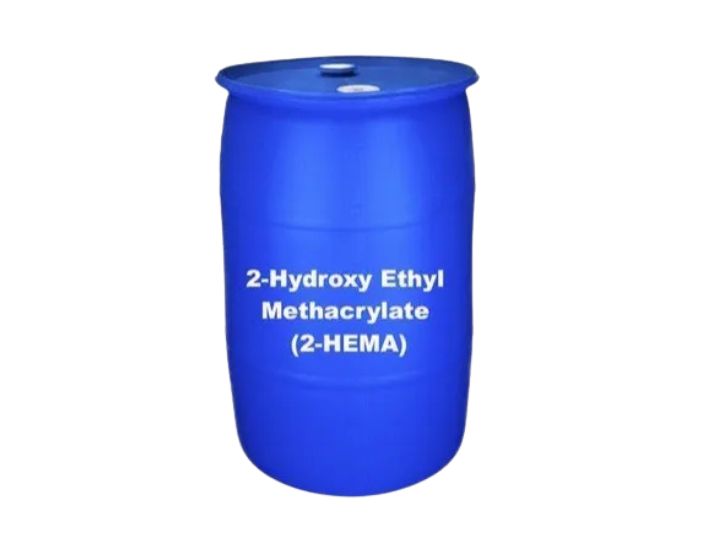
- Bulk Packaging Options: They supply range from lab scale (1 kg) to bulk drums (200 kg) with tamper evident seals.
- Safety & Training: We offer SDS, handling guidance as well as training tailored to industrial & laboratory users.
- Competitive Pricing: Economies of scale provide lower unit cost for importers & also distributors.
- Amazing Support: We assist with REACH, TSCA as well as other certifications to facilitate registration in Maharashtra.
Product Pack Size
Typical packaging includes:
Small Bottles: It has 500 g & 1 kg—ideal for lab/R&D.
Drums: 25 kg, 50 kg—suitable for pilot/R&D scale.
Totes/IBC Drums: 200–1000 kg—for industrial requirements.
Each container is labeled with batch & expiry, includes inhibitor details and sealed for chemical integrity.
Applications of 2-HEMA
- Soft Contact Lenses & IOLs
- Dental Materials
- UV-Curable Coatings & Adhesives
- Biomedical Hydrogels
- 3D Printing Resins
- Polymer Coatings & Microelectronics
- Embedding Medium
PHEMA hydrogels absorb water (10–600%) & also maintain clarity. It is foundational to soft contact lens technology since the 1960s.
This id integral to dental adhesives as well as composite resins, enhancing adhesion & also mechanical durability.
It is used in coating resins, sealants & also adhesives for enhanced flexibility as well as water resistance.
PHEMA serves in drug delivery systems, wound dressings, tissue scaffolds as well as implants. This is valued for biocompatibility and water retention.
Functions in UV-curable resins as well as silica-doped systems for 3D-printing applications, including foams and glass printing.
Applied in crosslinked acrylic resins for coatings and thin films in electronics.
Used in electron/optical microscopy as an embedding matrix due to clarity and polymer compatibility.
Frequently Asked Questions
Is 2-HEMA safe to handle?
It's an irritant and sensitizer (skin & eye). Handle with PPE, avoid inhalation, skin & eye contact.
What inhibitors prevent polymerization?
2-HEMA is stabilized with MEHQ (~180–250 ppm), but inhibitors deplete over time. This need proper storage because of this.
How do I store it?
Keep sealed, cool (2–8 °C), dark, well-ventilated, away from oxidizers and light.
What PPE is required?
Use eye/face protection, chemical-resistant gloves (nitrile/butyl), full suit, and possibly respirators in low-ventilation areas.
What’s the flash point?
Approximate flash point is 97 °C.
Can it be disposed down drains?
No it contains hazardous waste and dispose it as per local regulations.
What is its biodegradability?
Biodegrades readily (>90% in 14 days) with low bioaccumulation potential.
Is it flammable?
It is combustible at elevated temps; store accordingly.
Can you ship in IATA/ADR?
Generally not regulated as dangerous for transport, but always check current regulations.
What is its odor?
Odor is mild ester aroma as well as slightly pungent at higher concentrations.
In essence, 2-Hydroxyethyl Methacrylate (2-HEMA) is a pivotal monomer bridging functionality and practicality. With vinyl & hydroxyl groups, it allows formation of hydrophilic, biocompatible polymers useful in contact lenses, dental as well as UV-resins, adhesives, biomedical devices & also 3D-printed materials. Its technical-grade form (>98% purity, MEHQ-stabilized), manageable storage & clear safety profile. It is when handled properly—make it an industrial favorite. For organizations seeking a reliable supply, Shakti Chemicals in India, as leading suppliers, traders, dealers, importers and distributors, ensures top-quality products, regulatory support, and tailored technical service—empowering clients across industries.
Get in Touch with Us
Looking for high-quality 2-Hydroxyethyl Methacrylate? Contact us today for bulk orders and technical details.
Contact Us