
Butyric Acid Suppliers, Dealers in Mumbai, Maharashtra, India
Butyric Acid
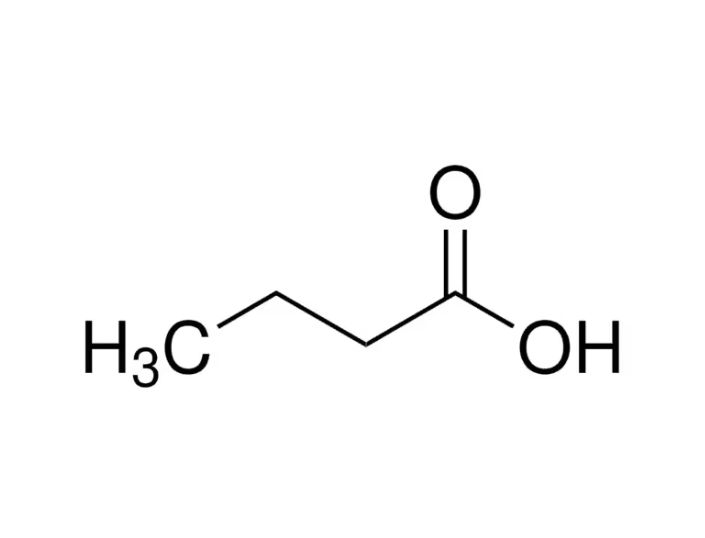
Butyric acid is also known as butanoic acid. It is a short-chain fatty acid known for its pungent odor & significant industrial, pharmaceutical as well as agricultural uses. It is found naturally in butter, cheese as well as human gut microbiota. It plays a crucial role in gut health, energy metabolism & also as a chemical building block in organic synthesis. In its purest form, butyric acid is a colorless as well as oily liquid with a characteristic rancid odor. Its versatility is great from use as a flavoring agent to a starting agent in butyrate salts as well as esters. It is extensively used across food, feed, fragrance & also polymer sector.
What Is Butyric Acid?
Butyric acid (IUPAC: butanoic acid) is a straight-chain, four-carbon carboxylic acid. It has the molecular formula C₄H₈O₂. It belongs to the family of short-chain fatty acids (SCFAs). It is known for their crucial roles in biological systems as well as industrial processes.
Natural Occurrence & Biological Role
Butyric acid environmetally occurs in animal fats as well as butter. This contributes to the distinctive “buttery” aroma. It is also a metabolic byproduct of anaerobic bacterial fermentation in the colon as well as rumen. In humans and ruminant animals, butyrate—the conjugate base of butyric acid—is a key energy source for colonocytes, influences gene expression through histone deacetylase inhibition, and exerts immunomodulatory effects.
Chemical Characteristics
It is a colorless, oil-like liquid at room temperature with a sharp, unpleasant odor often described as rancid or cheesy. Boiling point: 163.5 °C; melting point: −5.1 °C. It’s miscible with water at cooler temperatures and fully soluble in most polar organic solvents.
Chemical Specifications
| Property | Details |
|---|---|
| CAS Number | 107-92-6 |
| Chemical Name | Butyric Acid (Butanoic Acid) |
| Molecular Formula | C4H8O2 |
| Appearance | Colorless to pale yellow liquid |
| Odor | Strong, rancid (like butter or cheese) |
| Molecular Weight | 88.11 g/mol |
| Purity (GC) | ≥ 99.0 % |
| Assay | Min. 99.0% |
| Moisture Content | ≤ 0.5 % |
| Color (APHA/Hazen) | ≤ 50 |
| Melting Point | −5.1 °C |
| Boiling Point | 163.5 °C (at 760 mmHg) |
| Refractive Index | 1.387–1.390 |
| Density | 0.959 g/cm³ (at 20 °C) |
| Solubility | Miscible with water at lower temperatures; soluble in alcohol, ether, acetone |
| Storage Temperature | 2–8 °C |
| Shelf Life | 24 months when stored per guidelines |
Specifications
•Flash Point: Approximately 72 °C (closed cup), indicating moderate flammability risk during storage and handling.
•Autoignition Temperature: Around 420 °C which is beneficial for assessing thermal stability in processing scenerios.
•Vapor Pressure: ~0.4 kPa at 20 °C, showing moderate volatility as well as vapor release potential.
•Viscosity: Approximately 2.2 mPa•s at 25 °C. It is relevant for pumping as well as mixing applications.
•Log P (octanol-water partition coefficient): 0.79. This indicates moderate hydrophilicity.
•LD50 (oral, rat): About 2,940 mg/kg, which is utilized in toxicological risk assessments.
Handling and Storage
Butyric acid is corrosive & can be irritating to the skin, eyes as well as respiratory tract. It must be handled with strict & great precautions:
Handling
Use personal protective equipment: chemical-resistant gloves (nitrile, butyl), goggles, full-face shield, lab coat, and respiratory protection when aerosol or vapor formation is possible.
Operate in a ventilated or airy room or chemical fume hood.
Avoid inhalation, ingestion & also direct contact; do not eat, drink, or smoke when handling the chemical.
Storage
Store in airtight, corrosion-resistant containers (e.g., HDPE or glass).
Keep stored at 2–8 °C in a cool, dry, well-ventilated area away from heat sources, ignition points, and strong oxidizers.
Protect from moisture as well as light exposure.
Ensure secondary containment to avoid leaks.
Spill Response
In case of small spills, try to absorb with inert material (e.g., vermiculite).Wear full PPE.
Neutralize with dilute sodium bicarbonate, ensure ventilation, sweep into labeled containers, and dispose of per local regulations.
Fire Safety
Non-flammable but can ignite vapors. Try to extinguish with dry chemical, CO₂, or alcohol-defiant foam.
Avoid water spray to diminishing vaporization risk.
Waste Disposal
Collect acidic waste in sealed containers.
Neutralize before disposal following local regulations or use a licensed chemical waste disposal service.
Structure of Butyric Acid
Chemically, butyric acid is CH₃–CH₂–CH₂–COOH. The carboxyl group (–COOH) at the terminal end defines its acidity (pKa ≈ 4.82). It exists as a straight-chain molecule, forming dimers via hydrogen bonds in its pure liquid and solid states. Key structural features include:
Carboxyl moiety: acidic as well as reactive site.
Aliphatic backbone: contributes to hydrophobicity.
Hydrogen bonding: leads to dimer formation in non-polar environments.
Reactivity: undergoes esterification, neutralization, oxidation/reduction, and halogenation—all utilized in industrial chemistry.
Why Choose Shakti Chemicals as Your Butyric Acid Supplier?
Shakti Chemicals is your one-stop ideal choice as leading butyric acid suppliers, traders, dealers, importers, exporter or distributors in Mumbai, India. Here's what sets us apart in Maharashtra:
Premium Quality & Consistency: We guarantee ≥99.0% assay and low moisture, tailored to food, pharma, and industrial-grade demands.
Regulatory Compliance: Manufacturing under ISO, GMP & FSSC norms. we also give complete documentation for safe transport across borders.
Large-Scale Capacity: Ability to supply quantities from laboratory samples to bulk industrial tonnage. Very flexible packaging.
Global Reach & Logistics: As importers or distributors, we manage customs, compliance as well as delivery across India & export markets.
Technical Help: This includes item certification, handling guidelines & also formulation help.
Competitive Pricing: Optimized costs with transparent, long-term pricing as well as credit options.
Safety Focused: Dedicated QC labs, safe handling manuals as well as training.
End-to-End Services: From item selection to storage answers, quality audits & also after-sales support.
Product Pack Size
We offer butyric acid in a range of packaging to suit your needs:
25 kg HDPE/steel drums – It is ideal for lab-scale as well as pilot projects.
200 kg HDPE/steel drums – This is standard industrial packaging.
IBC Totes (1000 L) – This is bulk packaging for large-scale operations.
Customized packaging – This is available on request for special projects or regulatory needs.
Each package comes with tamper-evident seals, thorough product labels as well as comprehensive safety documentation.
Applications of Butyric Acid
1. Pharmaceuticals: Production of sodium/Ca butyrate, used in anti-inflammatory & also gastrointestinal health products.
2. Food & Feed Additives: As butyrate salts or esters it increases gut health and flavor in ruminant feeds; used as food flavors and aromatic agents.
3. Fragrance & Flavor Industry: As building blocks for fruity esters (e.g., butyl butyrate) in perfumes, deodorants & also flavor blends.
4. Chemical Intermediates: For manufacturing cellulose acetate butyrate, polyesters, plasticizers, esters as well as coatings.
5. Agriculture: Soil amendment additives, plant growth regulation as well as vermin repellents.
6. Biotechnology: Used in studying gut microbiome effects. They are the additives in anaerobic digestion as well as biogas processes.
7. Paints & Coatings: This helps in items requiring increased flexibility & adhesion.
8. Rubber & Plastics: In modifiers or plasticizer compositions.
9. Oil & Gas: This is used in drilling fluids as well as corrosion inhibitors.
10. Wastewater Treatment: As a carbon source to support denitrifying or in sulfate-reducing bacteria.
Frequently Asked Questions (FAQs)
1. What is the exact pH of this acid in aqueous solution?
At 0.1 M concentration, the pH is about 2.6–2.8 due to its acidic nature (pKa ≈ 4.82).
2. Can butyric acid be converted into its sodium salt?
Yes, neutralization with sodium hydroxide yields sodium butyrate. It is widely used in feeds as well as supplements.
3. Is butyric acid flammable?
Butyric acid itself isn't highly flammable. However, vapors can ignite when mixed with air as well as if exposed to heat or fire.
4. How do People handle spills?
Absorb spills with inert material, neutralize with bicarbonate, collect in suitable jars, then dispose per local regulations.
5. What odor mitigation steps are recommended?
Use activated carbon filters, scrubbers, or biofilters during transport & also during processing to minimize bad odor.
6. Is butyric acid biodegradable?
Yes, it's easily biodegradable & naturally occurs in the environment.
7. Can it irritate skin or respiratory system?
Yes, exposure may irritate skin, eyes as well as respiratory organs. PPE & proper airy scene are essential for safety.
8. Can it be transported by sea and road?
Yes—it is classified as a corrosive liquid. Proper packaging as well as documentation (IATA, IMDG, ADR compliance) are required.
9. How should it be stored long-term?
Store at 2–8 °C in sealed HDPE drums or glass bottles, sheltered from heat, light, and moisture.
10. Are there food-grade and industrial-grade versions?
Yes—food-grade meets food additive specifications, while industrial-grade is used for chemical processing and polymer synthesis.
Butyric acid is an all-rounder as well as short-chain fatty acid with valuable applications in food, feed, fragrance, pharmaceuticals as well as chemical industries. Its peculiar biological roles as well as chemical reactivity make it a major industrial chemical. With high purity, strong quality control, varied packaging & also full technical support, Shakti Chemicals is your preferred partner. This is the place whether you are looking for bulk industrial supply or specialized food-grade item. Our role as butyric acid suppliers, traders, dealers, importers guarantees end-to-end excellence from sourcing to delivery. Choose Shakti Chemicals to drive your processes with confidence & reliability.
Order Now
Contact us today for bulk inquiries, quotations, and technical documentation for Butyric Acid.
Contact Us- Address: 206-207, 2nd Floor, Wadala Udhyog Bhavan, Naigaon Cross Road, Wadala (West)
- Email: info@shaktichemicals.org
- Phone: +91 4044 0000